Which is the Best Payment Method for Small Businesses in the USA?
Which is the Best Payment Method for Small Businesses in the USA?
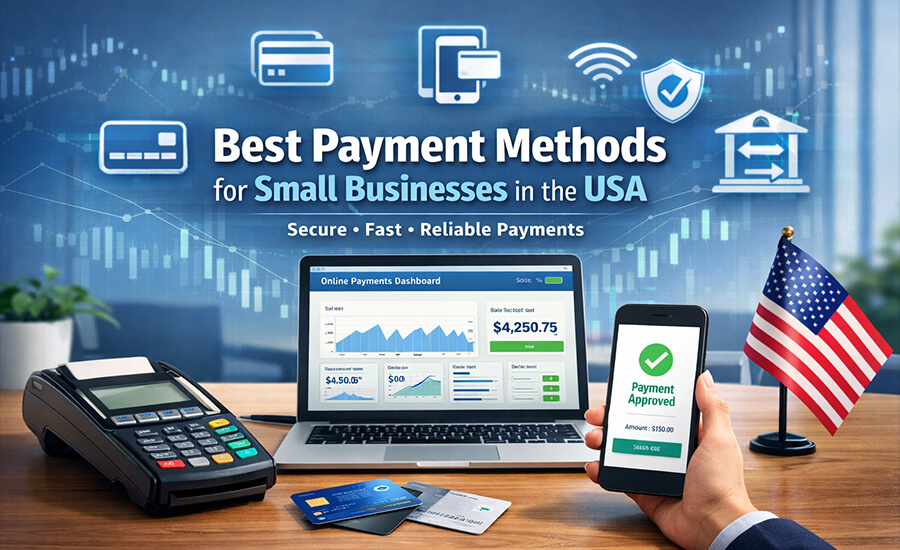
Operating a small business in the United States means that every dollar counts, and one of the most critical decisions you will make is how you accept those dollars. Choosing the right payment processing for small businesses isn’t just about convenience; it directly impacts your bottom line, customer satisfaction, and cash flow.
With multiple options available, you might find yourself wondering: which payment method truly reigns supreme? The reality is that the best choice depends on your volume, average transaction size, and business type. Let’s dive into the leading payment methods to help you decide which is the right fit for your unique needs.
- Credit and Debit Cards: The Consumer Favorites Credit and debit cards are undeniably the most familiar and widely accepted payment methods, making them a must-have for almost any B2C business. However, the way you choose to process these cards can drastically change your profitability.
When you set up card processing, you will generally encounter three main pricing models: flat-rate, interchange-plus, and tiered. Flat-rate pricing is simple and predictable, which is great for very small operations, but it becomes disproportionately expensive as your transaction volume grows. Tiered pricing bundles various interchange levels together, which can obscure your true costs and inflate your charges.
For most growing businesses, the best payment method is an interchange-plus model. This structure transparently separates the actual network fee from the processor’s markup. If your business processes more than $5,000 to $10,000 monthly, switching to an interchange-plus plan is the most cost-effective route, potentially saving you thousands of dollars annually compared to flat-rate alternatives.
- ACH Payments: The B2B and Recurring Billing Champion If your business relies on business-to-business (B2B) transactions, recurring subscriptions, or high-value invoices, Automated Clearing House (ACH) payments might be your best option. ACH payments transfer funds directly between bank accounts, bypassing the credit card networks entirely.
The biggest advantage of ACH is the cost. While credit card transactions usually involve a percentage fee ranging from 1.5% to 3.5%, ACH fees are typically a low flat fee per transaction, frequently capped at a maximum of around $5. Furthermore, ACH payments offer enhanced security. Because they undergo a standardized authorization process and bank-level fraud detection, they carry a lower risk profile than credit cards, which are highly susceptible to theft.
ACH also drastically reduces customer churn. Credit cards expire, get lost, or are stolen every three to five years, causing payment disruptions. Bank accounts, on the other hand, are typically kept for an average of 17 years, ensuring your recurring billing runs smoothly. Finally, detailed remittance information accompanies ACH transactions, simplifying your reconciliation process and boosting cash flow management.
- Buy Now, Pay Later (BNPL): The Sales Booster Buy Now, Pay Later (BNPL) schemes allow customers to delay full payment by paying a percentage upfront and the remainder in interest-free installments. This payment method is skyrocketing in popularity because it removes purchasing friction.
By offering BNPL, businesses can see significantly increased overall sales and higher average order values. Customers are far more likely to purchase higher-value items if they can break the cost into manageable monthly pieces. However, merchants must carefully weigh the drawbacks. When a customer uses BNPL, the provider typically charges the business a fee between 2% and 8% of the total transaction. If this method becomes wildly popular among your buyers, you will need to account for these extra fees when forecasting your cash flow.
Protecting Your Profits: Security and Hidden Fees No matter which payment method you choose, excellent payment processing for small businesses requires active cost management and robust security. Small businesses are prime targets for data thieves, and the fallout from a breach can be devastating. Always ensure your hardware and software are PCI DSS compliant, and utilize tokenization or Point-to-Point Encryption (P2PE) to render card data completely useless to hackers.
Additionally, be vigilant about hidden fees that pack a punch. Regularly audit your monthly statements for sneaky charges like batch fees, early termination penalties, or inflated PCI compliance fees. Using security tools like the Address Verification System (AVS) can help prevent fraudulent transactions and reduce costly chargeback fees, allowing you to maintain fee discounts.
Elevate Your Business with Binary Gateways Ultimately, there is no single “best” payment method—the optimal strategy usually involves a customized mix of credit card acceptance, ACH transfers, and modern solutions like BNPL. Navigating these options, deciphering fee structures, and avoiding hidden processor markups can be overwhelming.
That’s where Binary Gateways comes in. At Binary Gateways, we believe that payment processing for small businesses should be an asset, not an obstacle. We specialize in providing USA-based merchants with fully transparent, highly secure, and tailored payment solutions. Whether you need an interchange-plus credit card setup that scales with your volume, secure ACH processing to slash your transaction fees, or top-tier encryption to protect your customers, Binary Gateways is dedicated to empowering your success.
Stop losing your hard-earned profits to hidden fees and inflated rates. Partner with Binary Gateways today, and let us build the perfect payment ecosystem to help your business thrive.

Email us anytime!
Email customer service 24/7 at info@binarygateways.com

Call us anytime!
Reach customer care 24/7 at (801) 761-5001